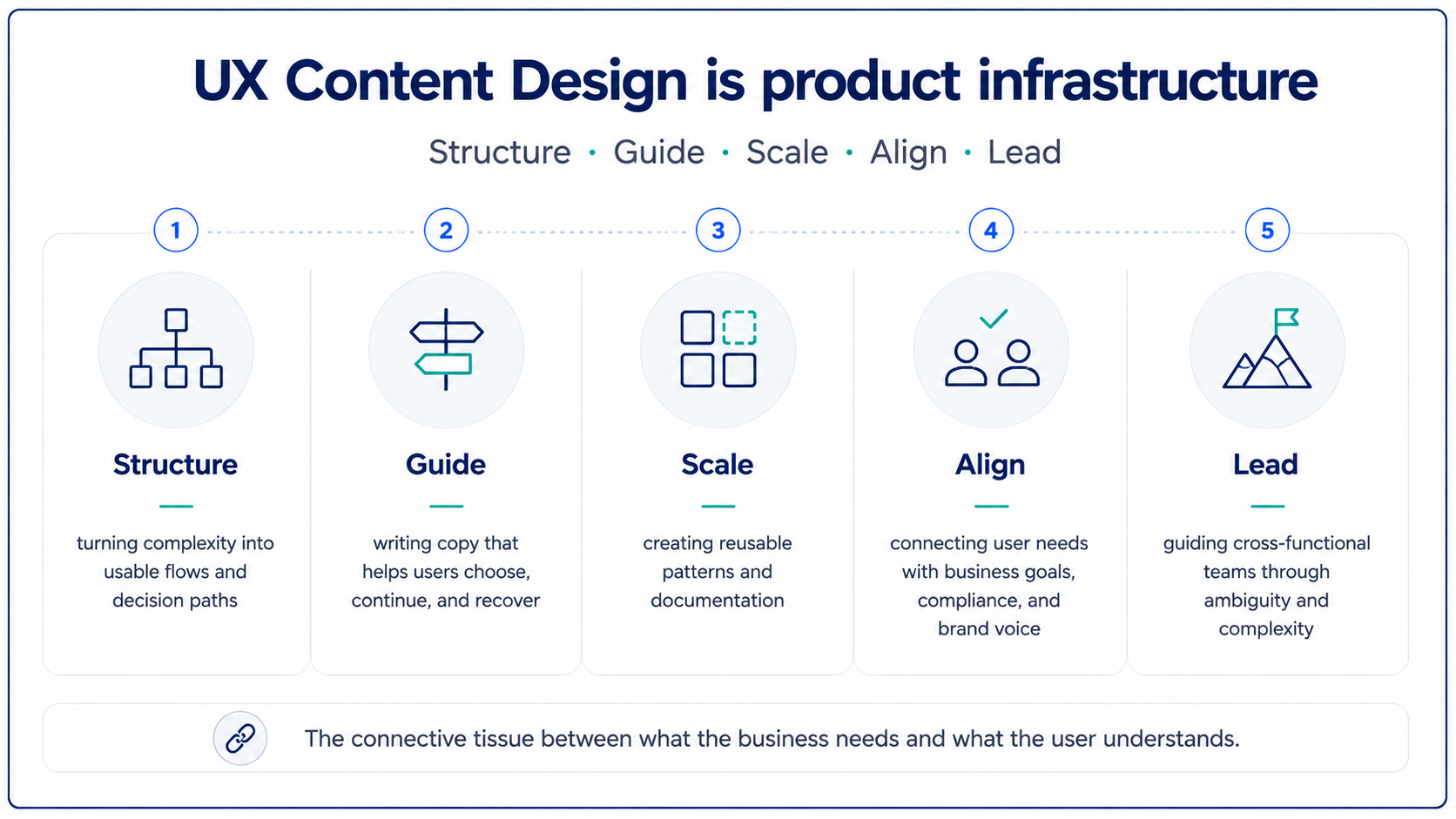
UX Writing & Content Design
Clear content for complex products, journeys, and decisions.
UX Writing · Content Strategy · Information Architecture · Journey Design · Content Systems
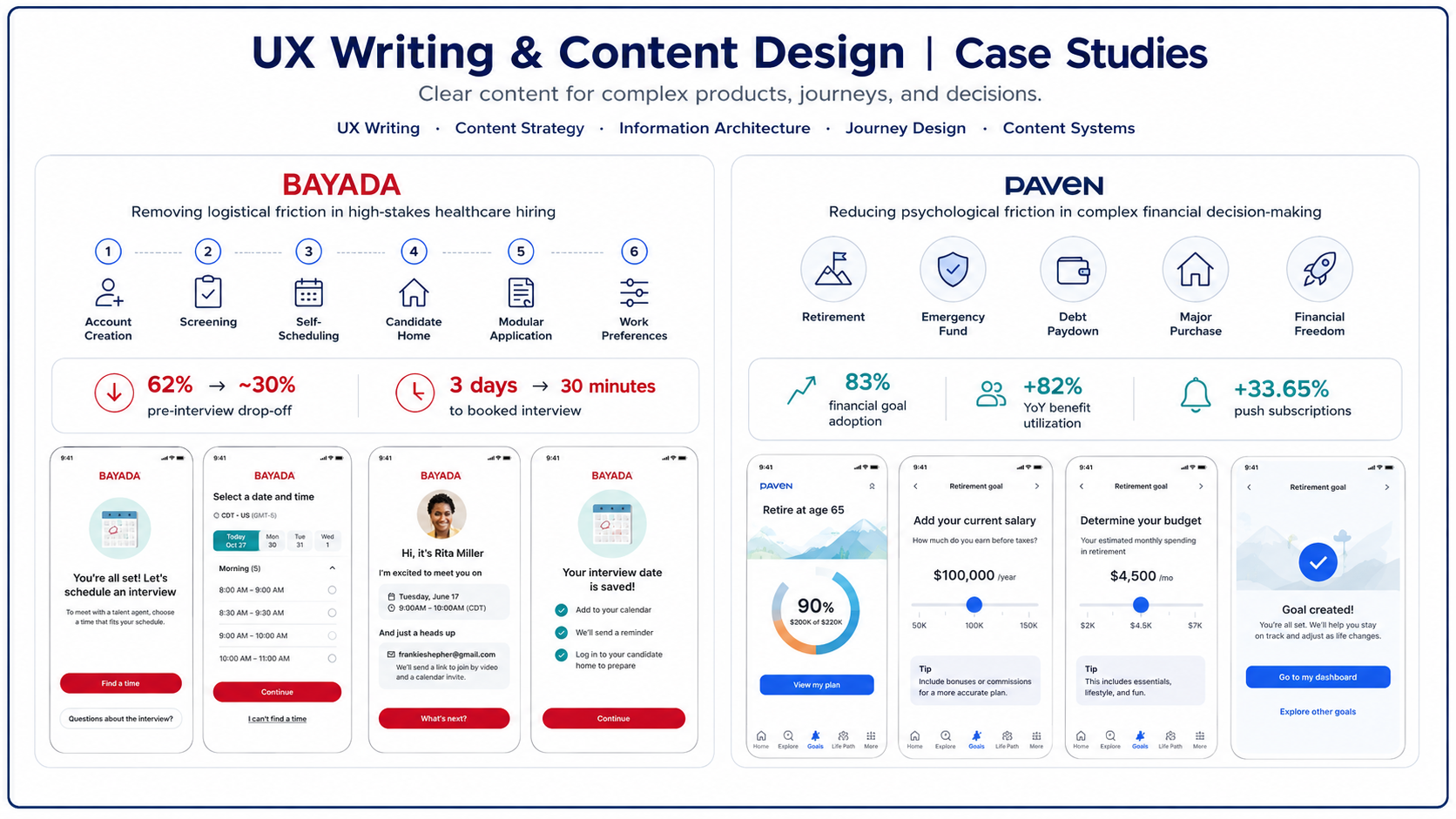
Featured Case Study 01 — BAYADA
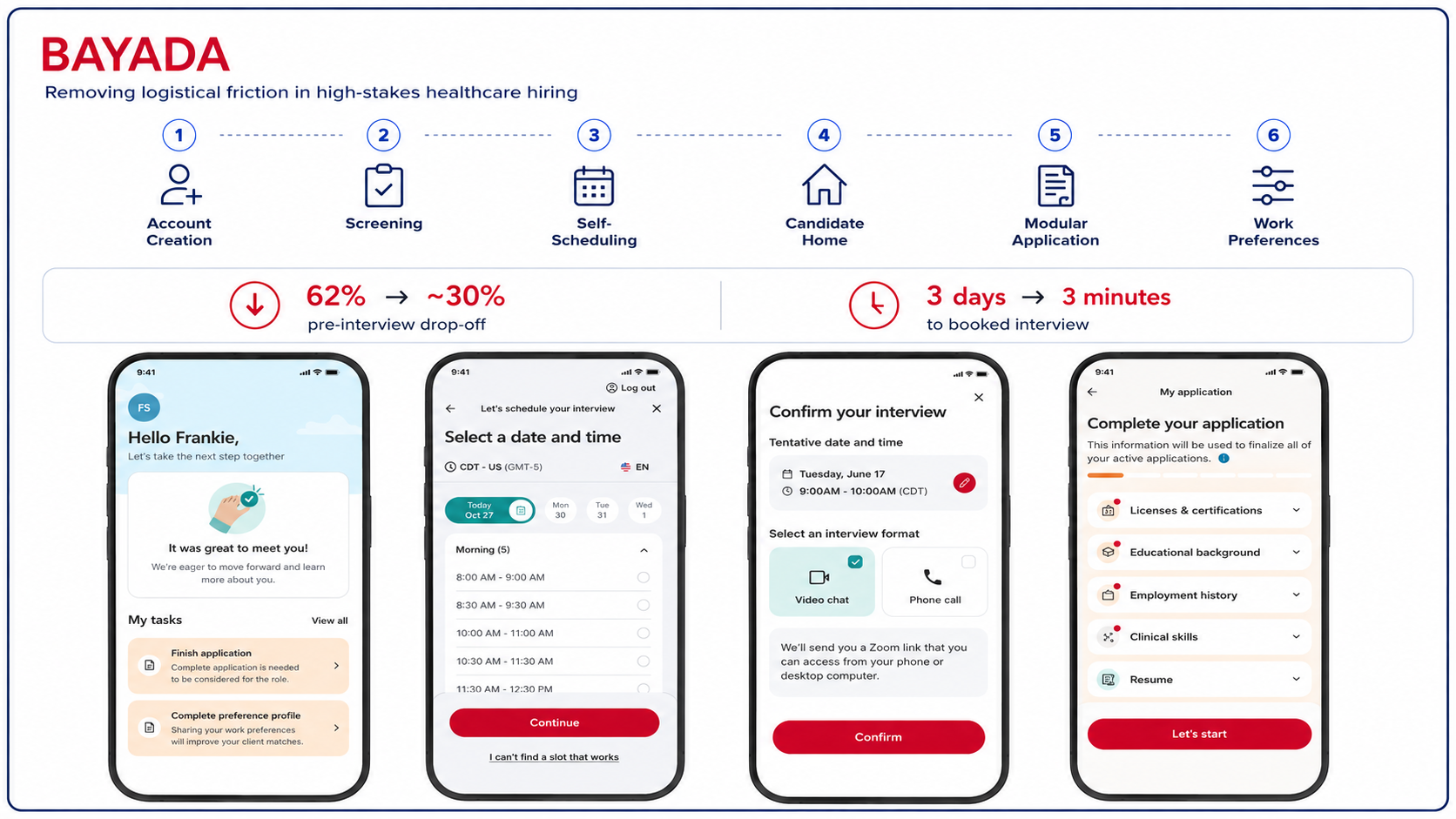
Removing logistical friction in high-stakes healthcare hiring
Challenge
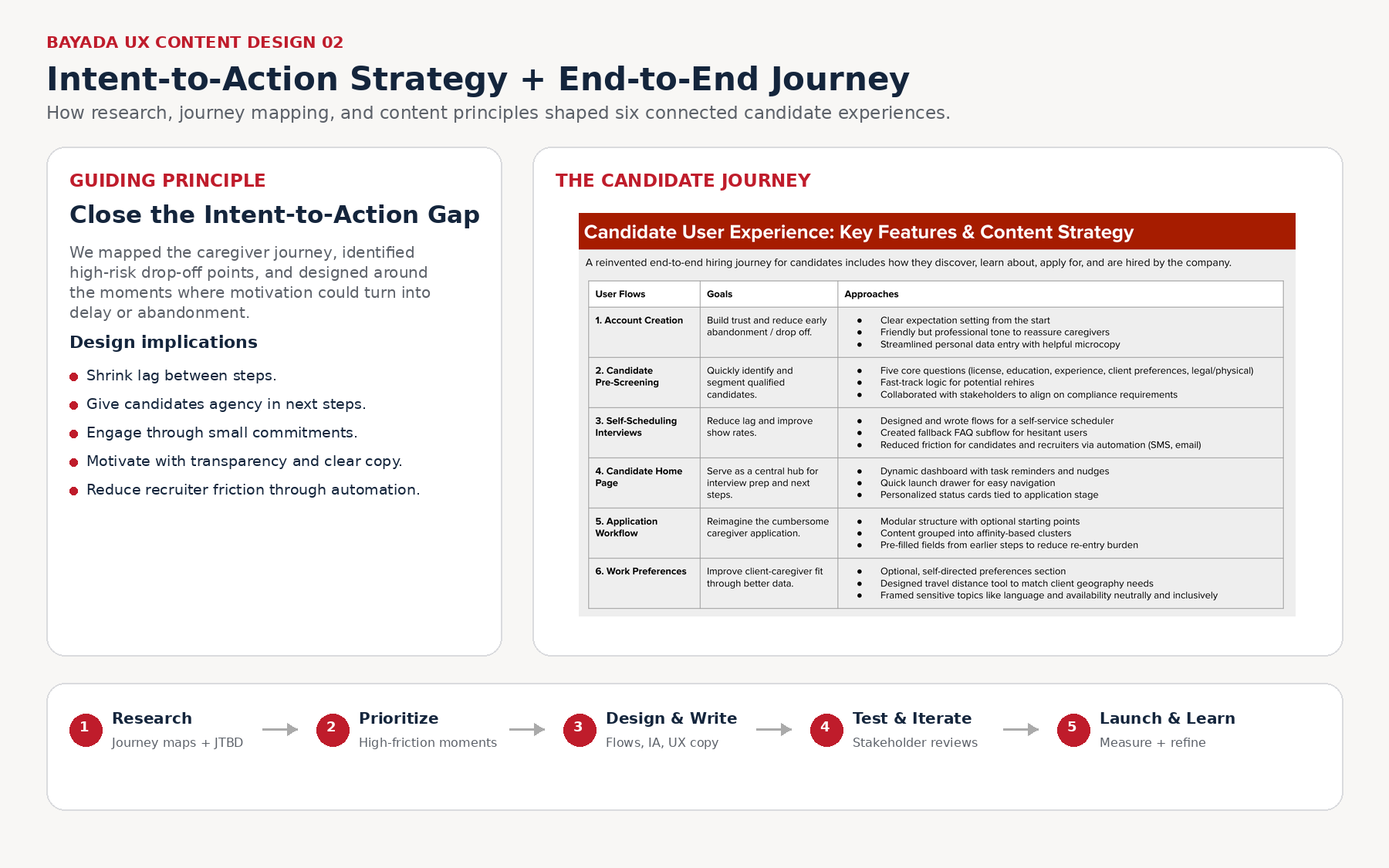
BAYADA’s hiring experience was losing candidates before the first interview. Long 10- and 32-page forms, scheduling delays, and manual recruiter coordination created friction across an already high-stakes healthcare hiring journey.
My contribution
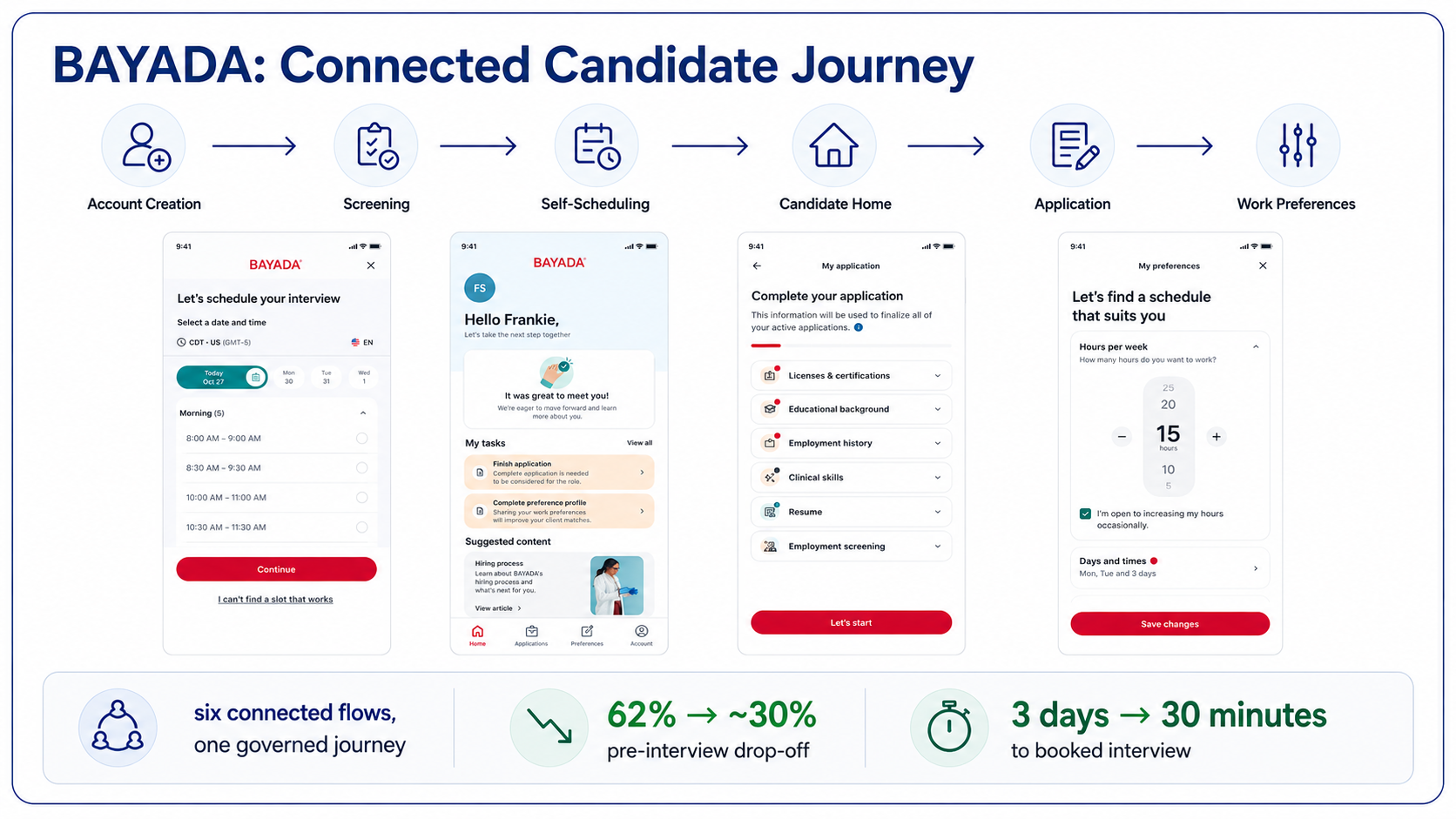
I redesigned the experience as six connected flows—Account Creation, Screening, Self-Scheduling, Candidate Home, Modular Application, and Work Preferences—using shared state logic, terminology, interaction patterns, and next-step guidance.
Result
Pre-interview drop-off: 62% → 30%
Qualification to booked interview: 3 days → 30 minutes
Takeaway
A complex hiring process becomes easier to complete when the journey itself (not just the copy) is designed around momentum, state, and the next useful action.
Featured Case Study 02 — BAYADA Self-Scheduling
Designing for readiness, not just completion
Challenge
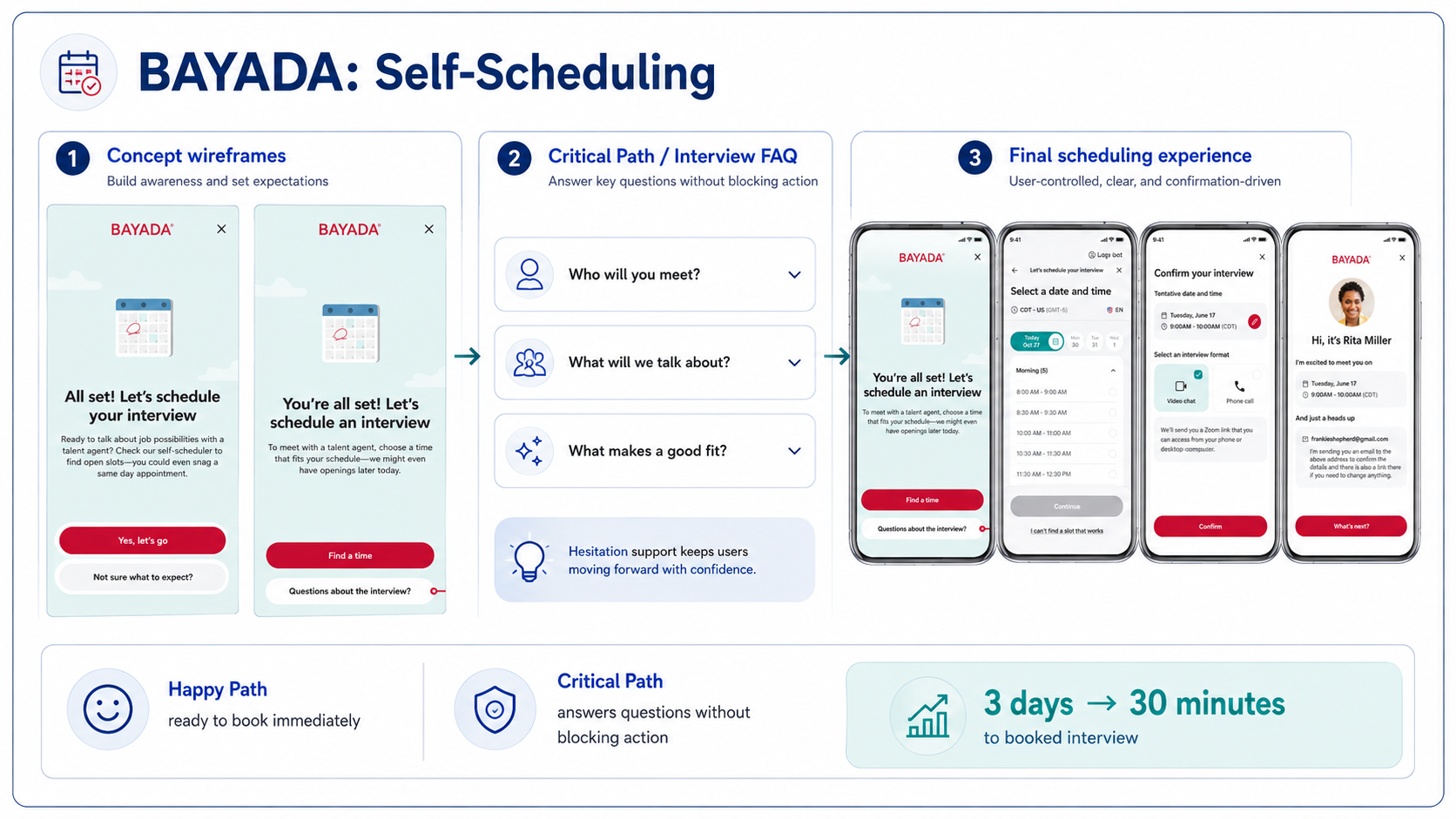
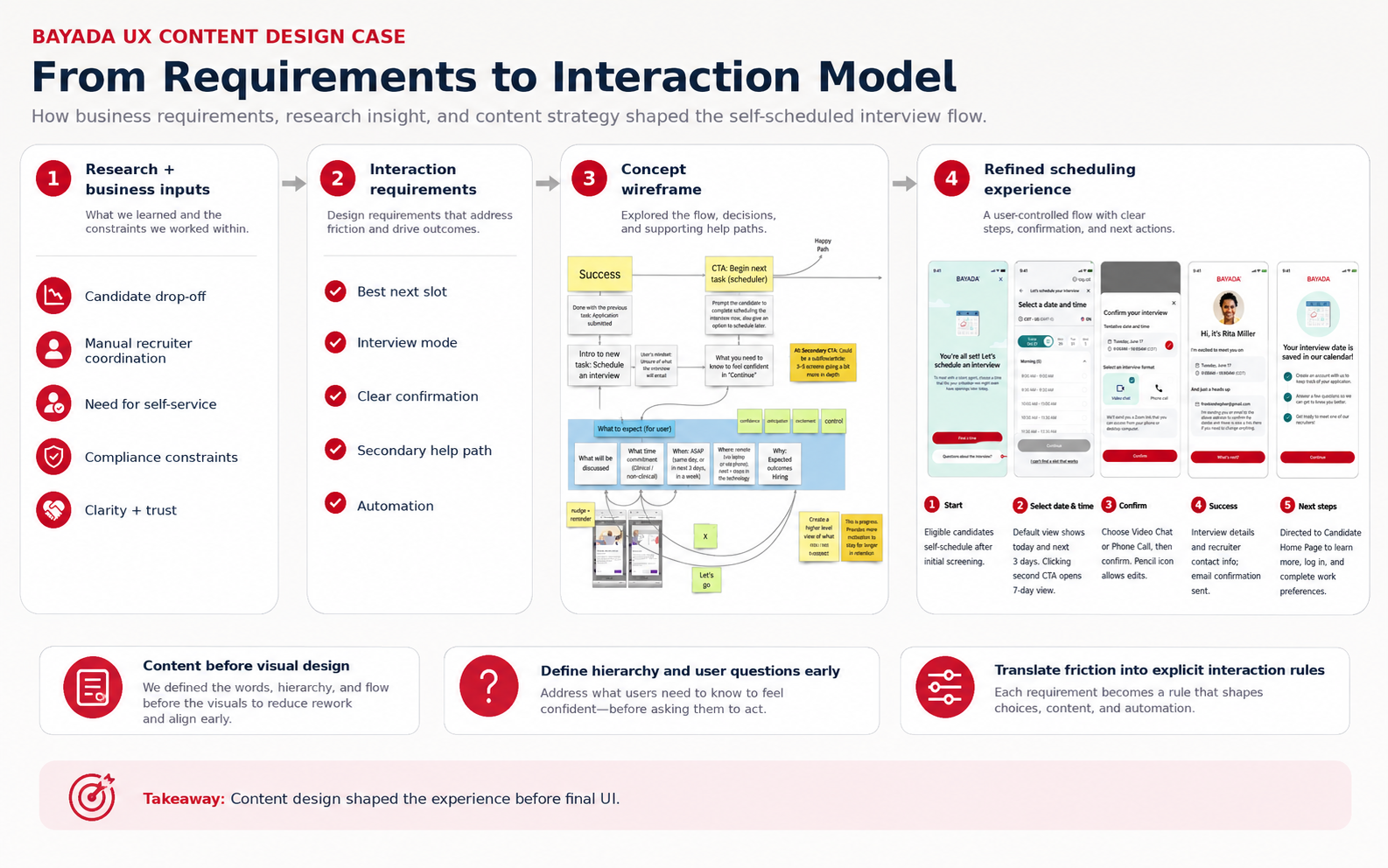
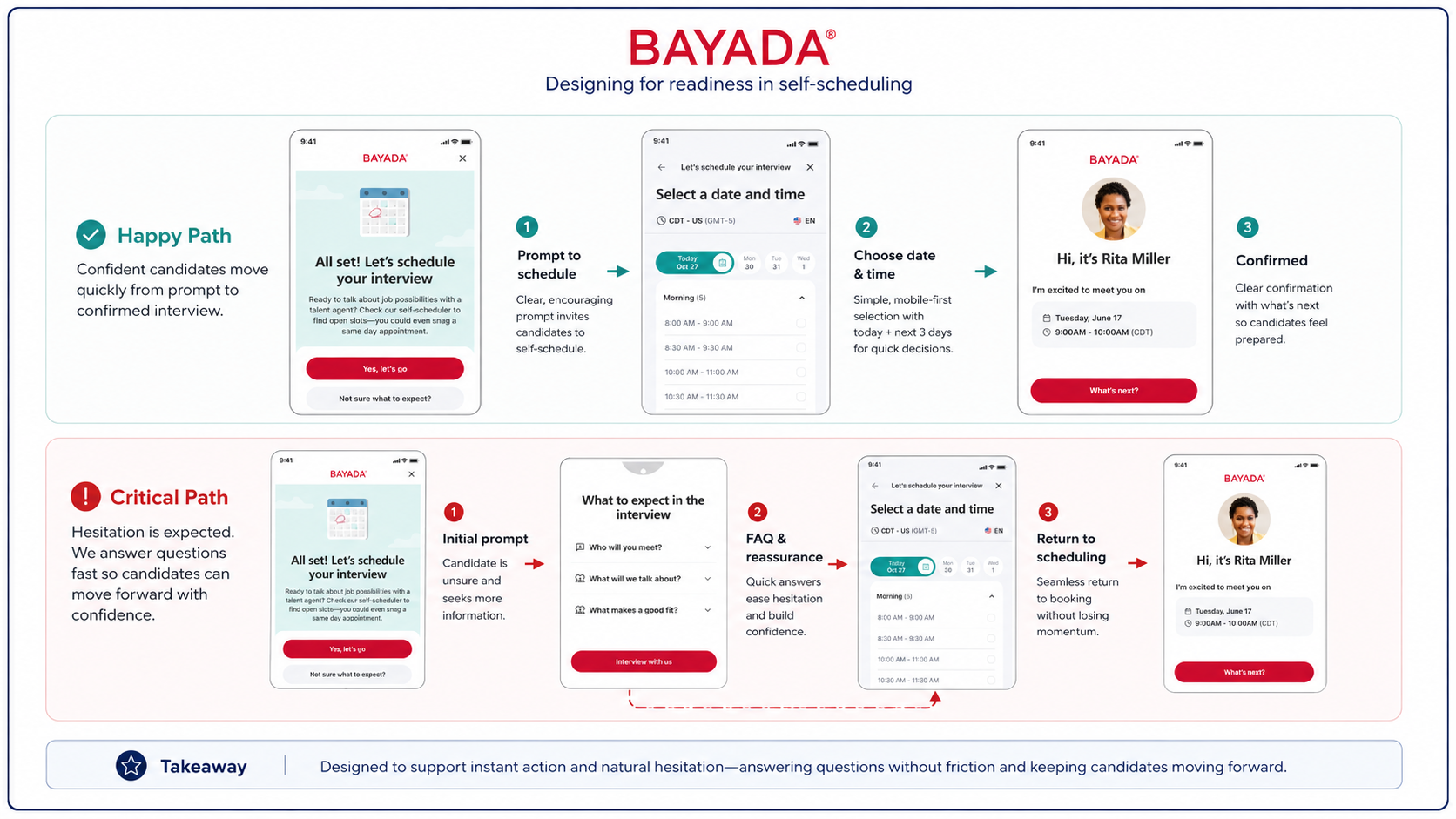
Qualified candidates did not all arrive at the scheduler in the same state. Some were ready to book immediately; others had questions or needed reassurance before committing.
My contribution
I modeled both a direct Happy Path and an alternate Critical Path, then translated requirements and user questions into content-led wireframes before final UI design. The supporting FAQ flow was iterated to answer common concerns without pulling users away from the scheduling task.
Result
3 days → 30 minutes from qualification to booked interview
Takeaway
Hesitation is not necessarily abandonment. The right alternate path can resolve uncertainty while preserving momentum.
Featured Case Study 03 — BAYADA Candidate Home + Application
Making a complex hiring process easier to understand
Challenge
Candidates had to manage interviews, tasks, application requirements, preferences, and changing hiring states without losing orientation.
My contribution
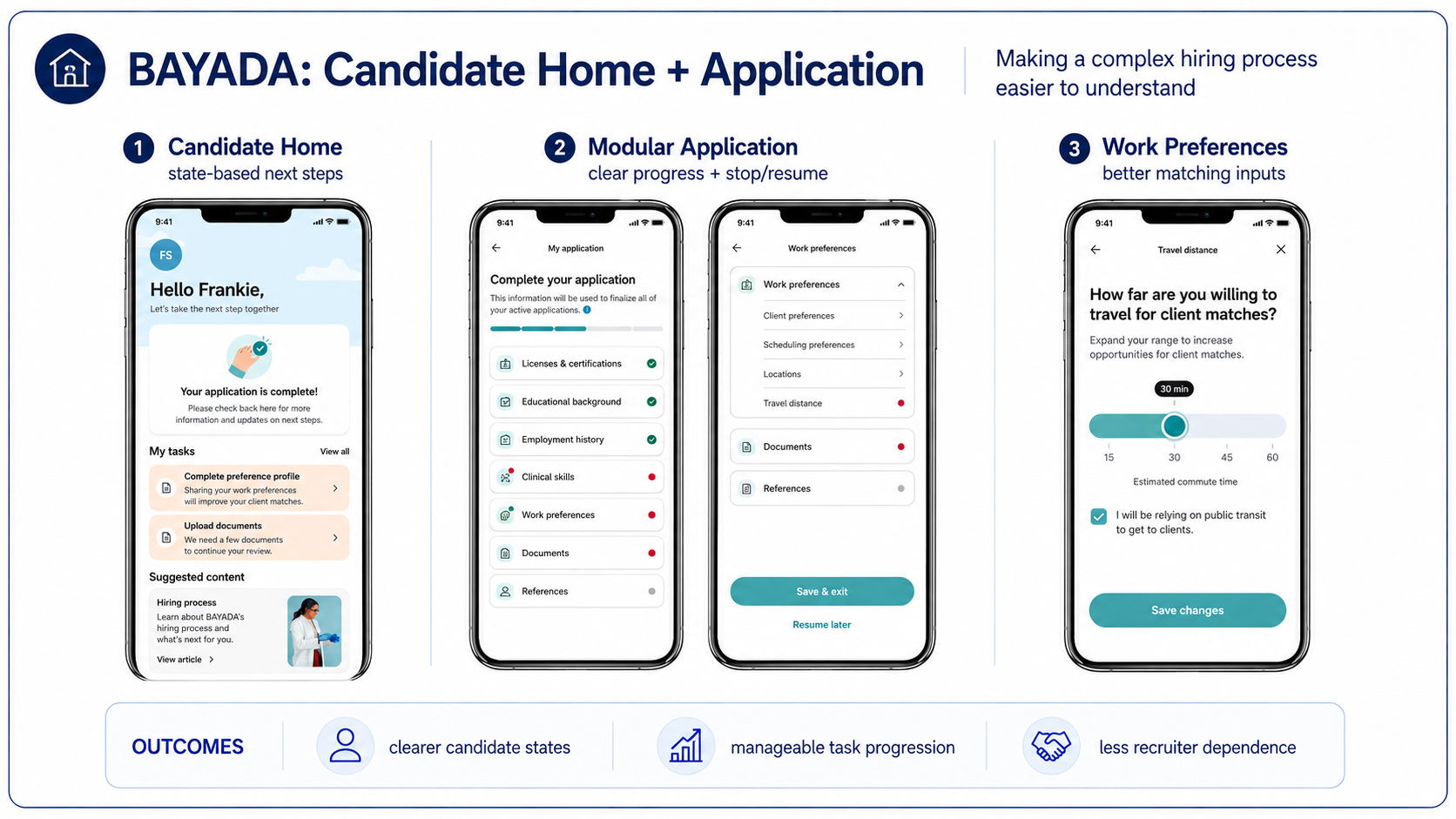
I structured Candidate Home around current state and next action, then reorganized long sequential application forms into modular, affinity-based sections with visible progress, prefilled information, and stop/resume support.
Outcome
Clearer candidate states, more manageable task progression, and less dependence on recruiter guidance.
Takeaway
Information architecture can remove friction before a single sentence is rewritten.
Featured Case Study 04 — Paven Financial Goals
Turning financial complexity into an actionable model
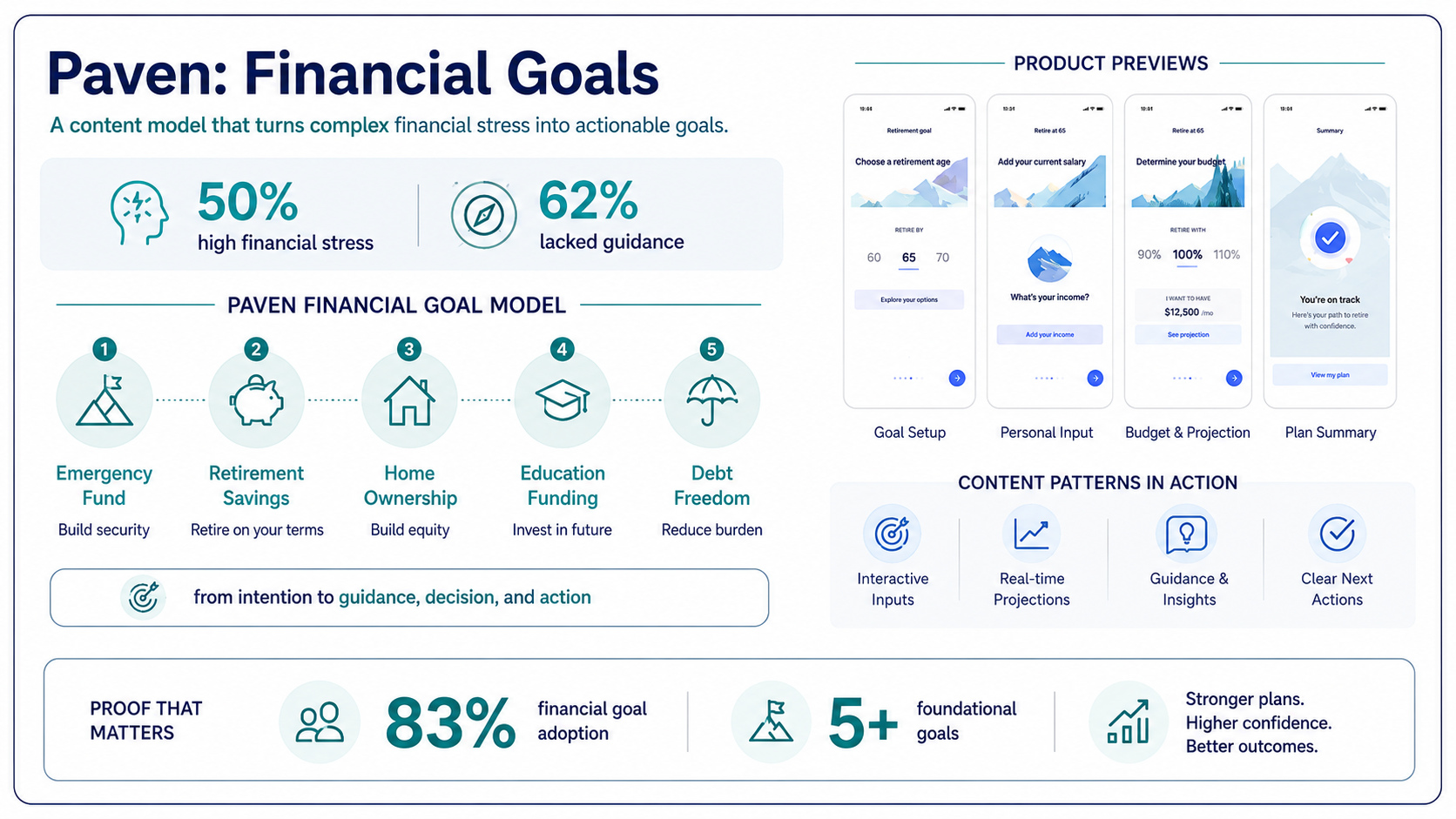
Challenge
Despite being well compensated, 50% of Meta employees reported medium-to-high financial stress, while 62% felt they lacked the guidance and knowledge needed to make confident financial decisions.
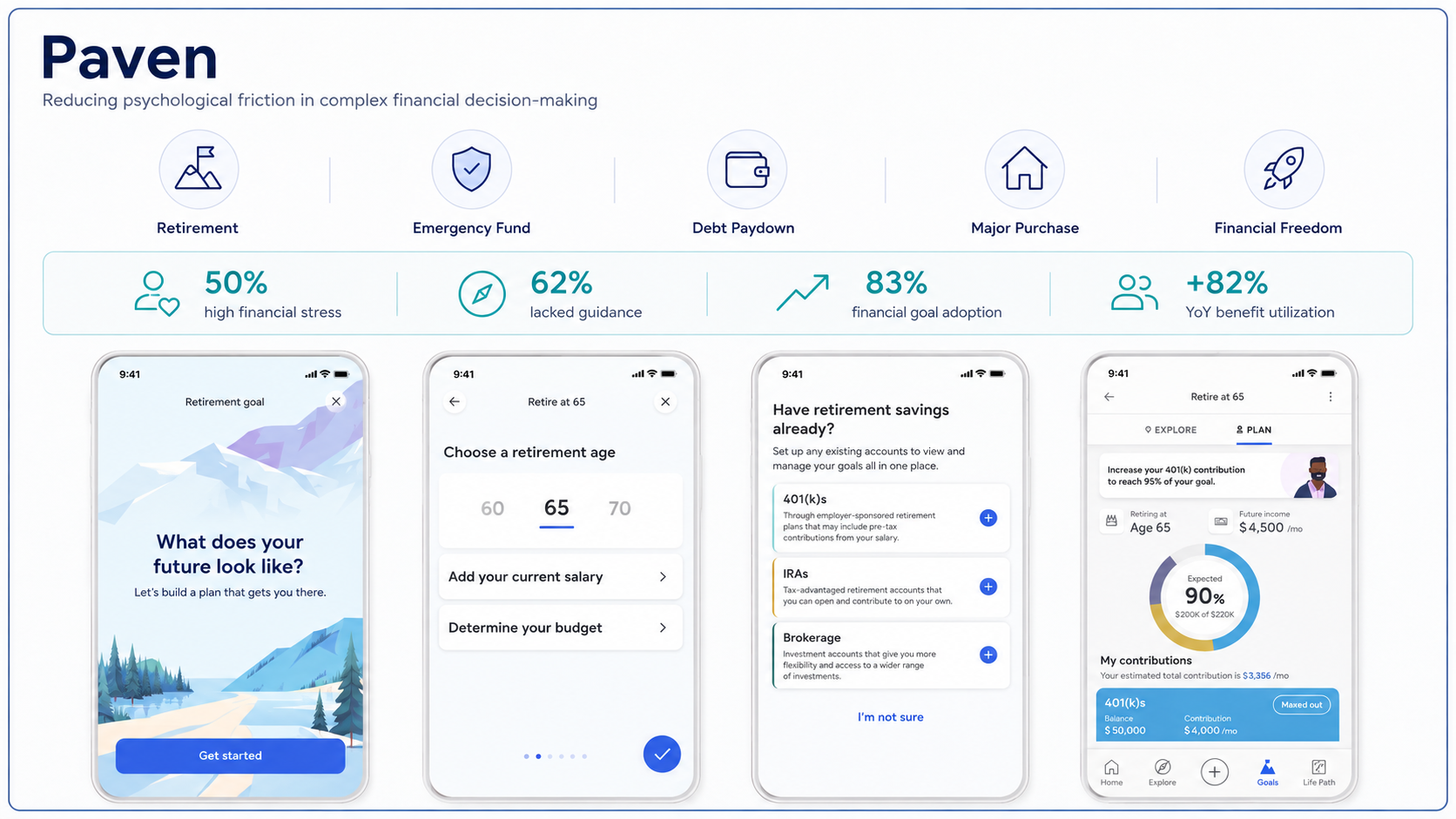
My contribution
I helped organize the product around five foundational financial goals rather than financial products or providers, creating a reusable goal-and-vehicle content model that connected user intent to guidance, decisions, tools, and progress.
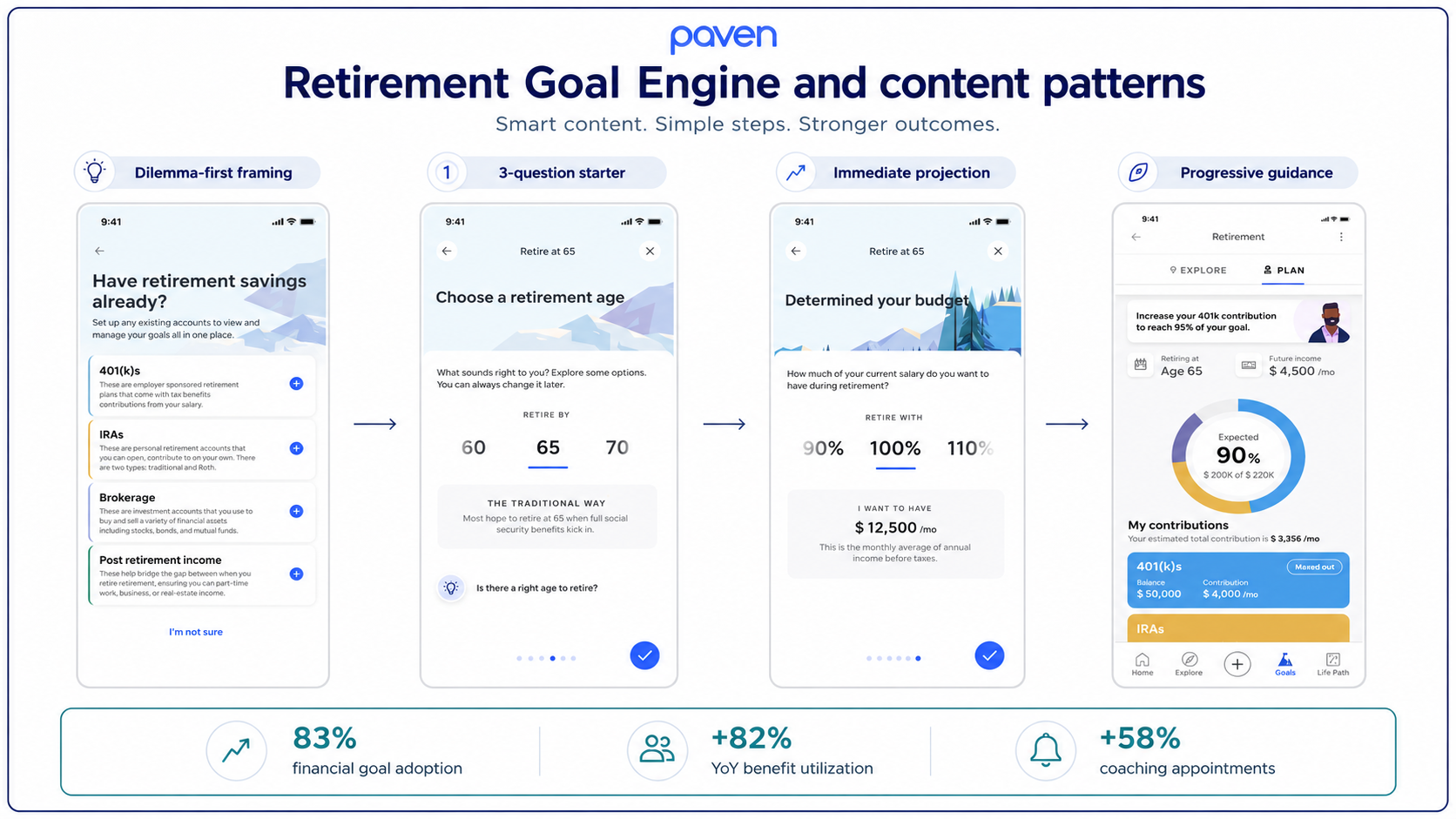
Result
83% financial goal adoption
Takeaway
Complex financial systems become more usable when the information architecture starts with what the user is trying to accomplish.
Featured Case Study 05 — Paven Retirement + 401(k)
Turning a distant financial goal into manageable decisions
Challenge
Retirement planning can feel abstract, emotionally distant, and intimidating—especially when users are asked for too much information before receiving any value.
My contribution
I designed a three-question starter that generated an immediate personalized projection, then progressively introduced retirement vehicles, contribution decisions, employer match, and ongoing dashboard guidance.
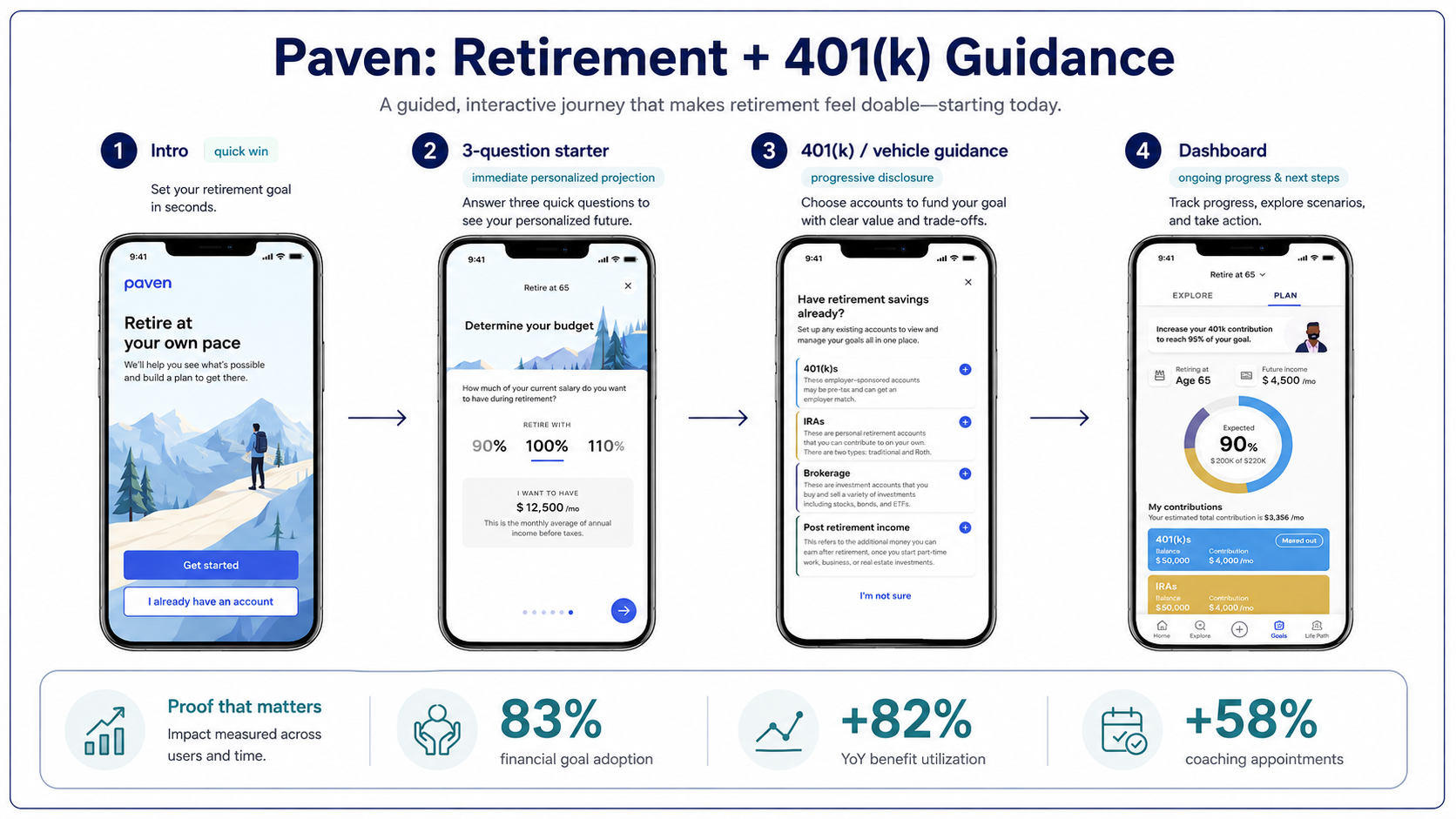
Result
83% financial goal adoption
The goal system gave users a low-friction entry into personalized retirement planning, with broader guidance available as complexity increased.
Takeaway
Immediate value and progressive disclosure can make distant, complex decisions feel concrete and manageable.
Featured Case Study 06 — Paven Voice + Content System
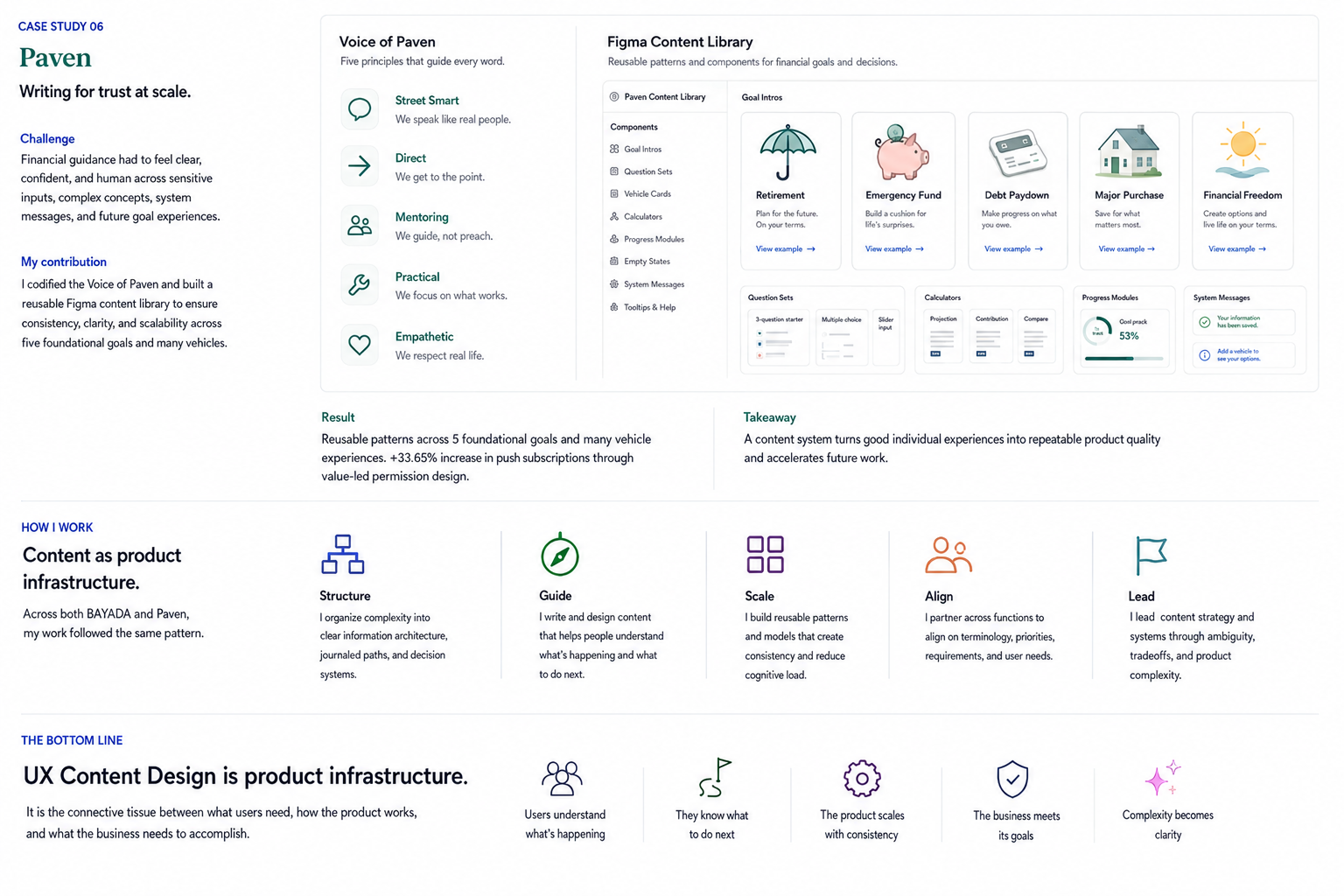
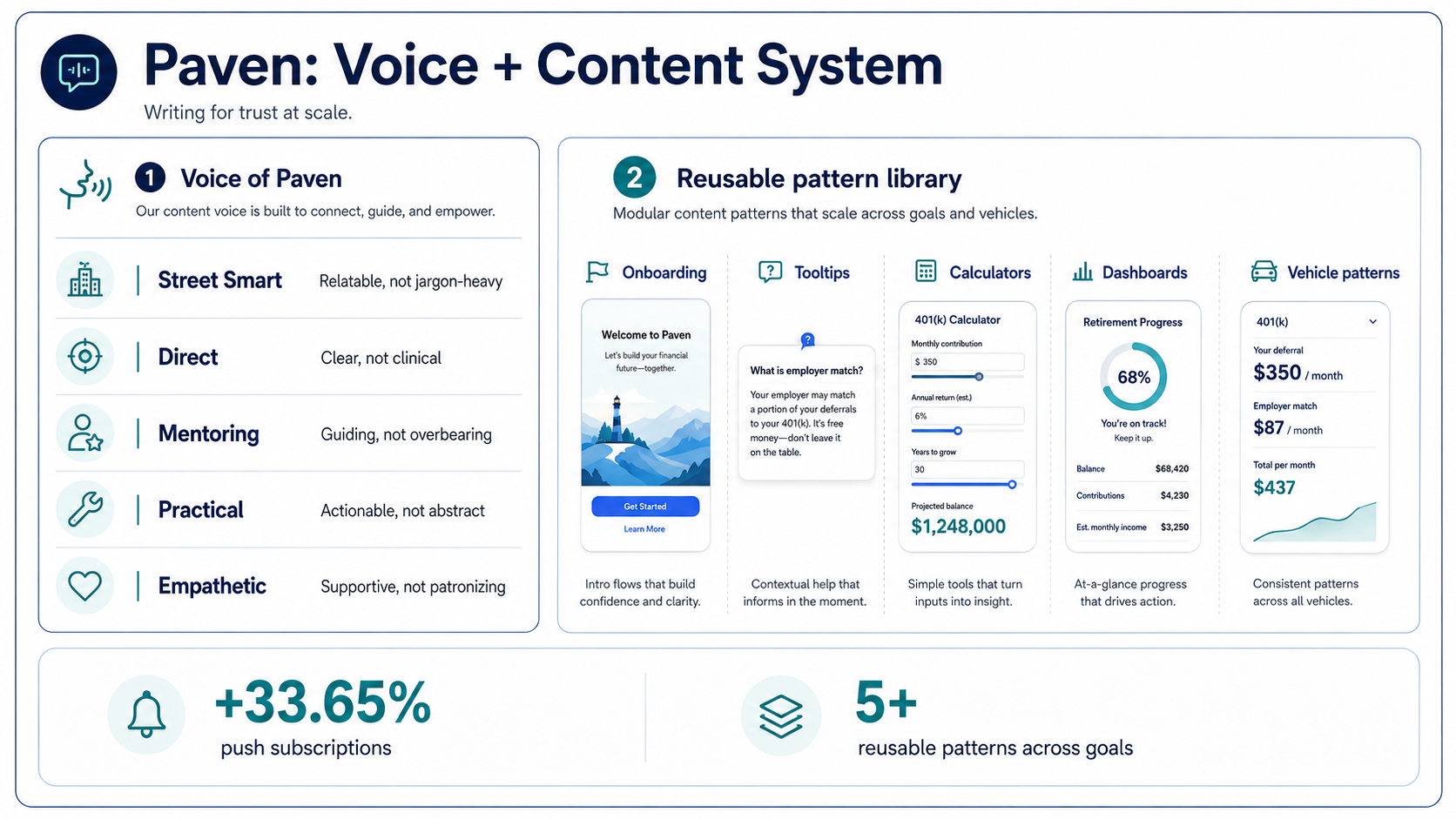
Writing for trust at scale
Challenge
Financial guidance needed to remain clear and empathetic across sensitive inputs, complex concepts, system messages, dashboards, and future goal experiences.
My contribution
I codified the Voice of Paven—Street Smart, Direct, Mentoring, Practical, and Empathetic—and helped translate recurring interaction patterns into a reusable Figma content library.
Result
Reusable patterns across five foundational goals and multiple vehicle experiences. Value-led permission design also contributed to a 33.65% increase in push subscriptions.
Takeaway
A content system turns good individual experiences into repeatable product quality.